If you’ve ever stood in a kitchen while someone sears a steak or simmers a big pot of spaghetti sauce, you know how quickly grease, steam, and cooking odors can fill the space. That’s where a kitchen exhaust fan comes in—not just to make the kitchen feel more comfortable, but to protect your cabinets from grease buildup, keep your air quality safe, and even prevent fires from excess grease in your ductwork. As a supplier of kitchen exhaust fans, I get questions about CFM ratings every single day, and it’s one of the most critical details customers need to get right when choosing the right fan for their space. Today, I’m breaking down what CFM actually means for a kitchen exhaust fan, how to calculate the right rating for your space, and why picking the wrong CFM can cost you in the long run. Kitchen Exhaust Fan
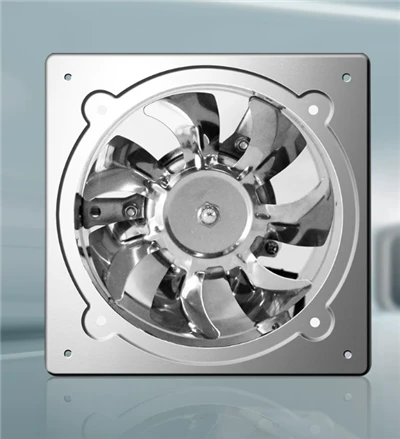
First, let’s get the basics straight: CFM stands for Cubic Feet per Minute, and it’s the measure of how much air a fan moves in one minute. For kitchen exhaust fans, this isn’t a random number on a box—it’s a scientifically backed rating that tells you how effectively a fan can clear out cooking byproducts. A lot of people assume a higher CFM is always better, but that’s not the case. A fan with too high a CFM will move air so fast that it wastes energy, makes loud noise, and might even pull conditioned air from adjacent rooms (like your HVAC system’s heated or cooled air, driving up utility bills). On the flip side, a fan with too low a CFM won’t clear steam, grease, or odors quickly enough, leaving you with sticky cabinets, lingering smells, and poor indoor air quality.
So how do you find the right CFM rating for your kitchen? There are two main methods used by HVAC professionals and code experts, and I’m going to walk you through both because that’s how we recommend it to our customers—no guesswork. The first method, which is the most commonly cited in building codes, is the “rule of thumb” method. The formula here is simple: take the volume of your kitchen (length x width x height) and multiply it by 15. Wait, let me explain that number. The 15 factor comes from the requirement that a kitchen exhaust fan should replace all the air in the kitchen about 15 times per hour. Divide that total by 60 (minutes in an hour) and you get 0.25, so another way to look at it is volume x 0.25, which is the same as volume divided by 4. For example, if your kitchen is 10 feet long, 12 feet wide, and 8 feet tall, the volume is 10x12x8 = 960 cubic feet. Multiply that by 15 and you get 14,400, then divide by 60 to get 240 CFM. That’s the baseline from this rule.
But wait, there’s a second method that’s more accurate because it accounts for how you actually use your kitchen. The National Kitchen and Bath Association (NKBA) and the American Society of Heating, Refrigerating and Air-Conditioning Engineers (ASHRAE) recommend this method, which is based on the size of your cooking surface, specifically the BTU rating of your stove or range. Why does BTU matter? Because stoves with higher BTUs generate more heat, steam, and grease when you’re cooking. For gas stoves, the formula is 100 CFM per 10,000 BTU. For electric stoves, it’s 50 CFM per 10,000 BTU. That’s a big difference, and it’s why this method is more tailored to how you cook. Let’s test this with the same example: a gas stove with a total of 20,000 BTUs would need 200 CFM, while an electric stove of the same BTUs would need 100 CFM.
Now, here’s where it gets important: when calculating your CFM, you also have to account for the length of your ductwork. This is a step that a lot of homeowners miss, and it’s why fans don’t perform as well as they’re rated. If your ductwork is longer than 25 feet, or if it has multiple turns, bends, or a flexible duct that’s not fully stretched out, the fan has to work harder to move air. Each 90-degree bend in ductwork is equivalent to adding about 5 feet of straight duct, and flexible duct can reduce airflow by up to 25% if it’s kinked or not properly installed. So if your baseline calculation is 240 CFM, but your duct is 35 feet long with two turns, you’ll need to add 20-50 CFM to make up for that airflow loss. At our company, we always warn customers about this because we’ve seen too many people buy a fan with the “right” CFM on paper, only to find it’s not clearing steam because their ductwork is poorly designed.
Another common question I get is about range hoods vs. built-in exhaust fans. A range hood is the hood that sits over your stove, while a built-in exhaust fan might be in your ceiling or wall. For range hoods, which are designed to capture air right at the source, the CFM calculation is the same, but you also have to consider the fan’s “sone rating.” Sones measure noise level, and no one wants a fan so loud that you can’t hear the TV or have a conversation while cooking. Most experts recommend a sone rating of 1 to 3 for range hoods, which is quiet enough for a kitchen. High CFM fans can have higher sone ratings, so it’s a balancing act between enough airflow and enough quiet. As a supplier, we carry models that hit that sweet spot—high CFM without excessive noise, because we know our customers want functionality and comfort.
Now, let’s talk about building codes, because this isn’t just a suggestion—it’s often required. In the United States, the International Residential Code (IRC) mandates that kitchens have exhaust ventilation with a minimum CFM of 50, but that’s for a small, low-cooking-use kitchen. For most homes, the IRC refers to ASHRAE Standard 62.2, which requires that kitchen exhaust fans move enough air to dilute cooking pollutants. If you’re renovating your kitchen or adding a new stove, checking your local building code is important because some areas require higher CFM for gas stoves or larger kitchens. For example, in areas with stricter indoor air quality rules, a 200 CFM minimum might be required, even for a small kitchen.
I want to share a real example from a customer last year to show how this works. A couple in Austin bought a home with a tiny 10×10 kitchen and a 10,000 BTU electric stove. They bought a 100 CFM fan because they thought that would be enough, but after moving in, they noticed that when they made a big pot of chili, the steam would stick to their windows and the walls would get damp. They called us, and we walked through the calculations: their kitchen volume was 800 cubic feet, so the rule of thumb said 200 CFM, and their electric stove needed 50 CFM, but their duct was 30 feet long with one turn, so we recommended 220 CFM. They upgraded, and they told us a month later that they no longer have damp walls or lingering chili smells. That’s exactly why getting the right CFM matters—it’s not just about numbers on a box, it’s about making your kitchen work for you.
One myth I hear all the time is that a higher CFM will always be better for cleaning grease. That’s not true, especially if your ductwork can’t handle the extra airflow. A fan with too high a CFM will pull air so fast that it can’t capture all the grease particles—some will escape into your kitchen or get stuck in the ductwork. Grease buildup in ducts is a major fire hazard; the NFPA reports that kitchen fires account for over 100,000 home fires every year, and grease in exhaust ducts is a leading cause. When a fan is sized correctly, it moves air at the right speed to capture grease and push it out the duct, preventing that buildup. Too fast, and the grease doesn’t get pulled out; too slow, and it stays in the kitchen and ducts.
Another factor to consider is if you have an open-concept kitchen. If your kitchen is connected directly to your living room or dining room with no walls, you might need a higher CFM, because the fan has to clear air across a larger space, not just a small enclosed kitchen. For open-concept kitchens, add 25-50 CFM to your baseline calculation to make sure odors and steam don’t spread into the rest of your home. I had a customer in Dallas who had an open kitchen connected to his family room, and he originally bought a 250 CFM fan, but we recommended 300 CFM because of the open layout. He said that after installing the higher CFM fan, he no longer smells bacon in his bedroom the next morning, which was a constant problem before.
As a supplier, we’ve seen a lot of customers make mistakes when choosing a kitchen exhaust fan, mostly because they don’t understand CFM. That’s why we make it a point to walk through the entire process with every customer, not just give them a number. We ask about their kitchen size, their stove type and BTU, their duct length and layout, and if they have an open-concept kitchen. We also explain the difference between rated CFM and actual airflow—some fans are tested in a controlled lab, and their real-world airflow is lower, so we only carry fans that are third-party tested to meet their CFM claims. That’s important because there are a lot of brands that overstate their CFM to sell more fans.
Let’s wrap this up with a quick checklist so you can calculate your own kitchen’s required CFM: 1. Measure your kitchen’s length, width, and height to get volume (L x W x H). 2. Use the rule of thumb: Volume x 15 (then divide by 60) = baseline CFM, or use the stove method: (Gas stove BTU / 10,000) x 100 or (Electric stove BTU / 10,000) x 50. 3. Adjust for ductwork: add 5 CFM per foot of duct over 25 feet, plus 5 CFM per turn. 4. Adjust for open-concept: add 25-50 CFM if your kitchen is open to other living spaces. 5. Check local building codes for minimum requirements.

If you’re renovating your kitchen, replacing a range hood, or just looking to upgrade your exhaust fan, getting the right CFM is key to better air quality, less grease buildup, lower utility bills, and a more comfortable kitchen. At our company, we’ve been supplying high-quality, third-party tested kitchen exhaust fans for years, and our team is here to help you find the perfect fit for your space. Whether you’re a homeowner doing a small remodel or a contractor working on a new build, we can provide the guidance you need to make the right choice. We don’t believe in pushing a fan with too high or too low a CFM—we believe in matching the fan to your actual needs, because that’s what gives you the best results long-term. If you’re ready to discuss your project and find the right kitchen exhaust fan, reach out to our team today to connect with our sales and support experts who can walk you through every step of the process.
Simple Stainless Steel Kitchen Hood References
ASHRAE Standard 62.2: Ventilation and Acceptable Indoor Air Quality in Low-Rise Residential Buildings
International Residential Code (IRC) 2021, Chapter 12: Mechanical Systems
National Kitchen and Bath Association (NKBA) Kitchen Design Guidelines
National Fire Protection Association (NFPA): Kitchen Fire Safety Facts
Jiaxing Zenterest Import & Export Co., Ltd.
With abundant experience, we are one of the most professional kitchen exhaust fan manufacturers and suppliers in China. Please feel free to wholesale high quality kitchen exhaust fan made in China here from our factory. We also accept customized orders.
Address: Room 101-3, Building 46, Zhifu Center, Gaozhao Subdistrict, Xiuzhou District, Jiaxing City, Zhejiang Province, P.R.China
E-mail: bonnie.wu@zenterestvent.com
WebSite: https://www.zenterestvent.com/
