If you’ve ever shopped for screening equipment components, chances are you’ve stumbled on polyurethane screen panels—they’re everywhere in mining, aggregate processing, recycling, and even food and pharmaceutical handling, and for good reason. As a polyurethane screen panel supplier, I get asked this question at least once a week: “What is the compression modulus of a polyurethane screen panel?” It’s not a trivial detail, either—this number shapes how panels hold up under heavy loads, resist permanent deformation, and perform over years of continuous use. Let me break this down like I would for a customer who’s comparing quotes, not just regurgitate textbook jargon. Polyurethane Screen Panel
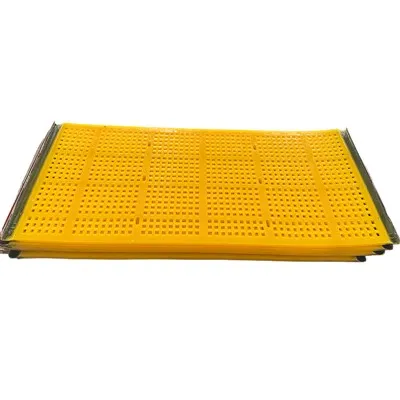
First, let’s get the basics straight: compression modulus, also called elastic modulus or Young’s modulus for compression, is a measure of how much a material resists being squashed when force is applied. In simple terms, it’s the stiffness of the material. For a screen panel, this isn’t just an abstract material property. If a panel is too flexible, it’ll stretch or bend under the weight of tons of rock or ore on a vibrating screen, leading to uneven wear, screen plugging, and frequent replacements. If it’s too stiff, it’ll be brittle, crack when hit by sharp aggregate, or not vibrate correctly to separate material efficiently. That’s why getting the compression modulus right is make-or-break for end users, and as a supplier, it’s the first specification I dig into before recommending a panel for a customer’s specific application.
Now, polyurethane screen panels aren’t one-size-fits-all, so their compression modulus isn’t a single fixed number. It ranges, usually, from about 100 MPa (megapascals) up to 700 MPa, depending on how the polyurethane is formulated. Let’s talk about what changes that number. The base polymer is a huge factor—different polyols (the building blocks of polyurethane) react with diisocyanates to create materials with very different stiffness. For example, polyether-based polyurethanes tend to be more flexible, so their compression modulus sits around the lower end of that range, 100 to 300 MPa. These are great for applications where vibration flexibility is key, like fine screening of 1mm to 10mm aggregate, where the panel needs to bounce back quickly without breaking. Polyester-based polyurethanes, on the other hand, are much more rigid, with compression modulus closer to 500 to 700 MPa. These are heavy-duty workhorses for mining, where you’re moving 100-ton chunks of rock and need a panel that won’t deform even under massive static and dynamic loads.
Then there’s how the panel is manufactured. The molding process, the amount of cross-linking agents added during production, even the additives we mix in—like anti-oxidants or UV stabilizers for outdoor applications—all tweak the compression modulus. As a supplier, I don’t just mix a batch of polyurethane and pour it into a mold. If a customer is screening gold ore in a mine in Nevada, where temperatures swing from -10°F in winter to 100°F in summer, I’ll adjust the formulation to keep the compression modulus consistent across that temperature range. If they’re screening plastic recyclate, where sharp edges of PVC can cut through the panel, I’ll balance modulus with abrasion resistance, not just stiffness.
Wait, let’s clear up a common misconception here: compression modulus isn’t the same as hardness, which is what a Shore A or Shore D test measures. Hardness is a surface test—it tells you how hard the outer layer of the material is, but it doesn’t account for how the material deforms under a load spread over a larger area, like a pile of ore sitting on a screen panel. A polyurethane panel that tests at 85 Shore A might have a compression modulus of 200 MPa, while another 85 Shore A panel could have a modulus of 400 MPa, depending on its formulation. That’s why I always tell customers not to pick a panel just on Shore hardness numbers—ask for the compression modulus, and ask what application it’s designed for.
Let’s put this in real-world terms. Last year, a customer from a gravel quarry in Arizona reached out to me complaining their 10-gauge polyurethane panels were only lasting 3 months, compared to the 6-month lifespan they expected. Their current panels had a compression modulus of 250 MPa, which is standard for general-purpose screening, but their quarry screens 2-inch to 6-inch rock at a 1,200 tons per hour rate. That’s a lot of dynamic force—every time the screen vibrates, the panel compresses slightly under the impact of large rocks. The lower-modulus panel couldn’t bounce back fast enough, so the wire mesh in the panel started to stretch, leading to uneven wear on the edges and premature failure. I recommended switching to a heavy-duty panel with a compression modulus of 550 MPa, matched with a stiffer backing plate, and their panel lifespan jumped to 11 months. That’s the difference understanding compression modulus makes.
Another example: a food processing customer who screens potato starch for use in baby formula. They needed a panel that’s flexible enough to separate fine starch particles without clogging, but not so stiff that it would shed polyurethane particles into the food, which would cause contamination. We worked with them to develop a custom formulation with a compression modulus of 180 MPa—flexible enough to vibrate quickly and prevent plugging, rigid enough to hold its shape and not shed fragments, and formulated with FDA-approved materials. That’s the kind of tailored solution I focus on as a supplier, not just off-the-shelf panels.
How do we actually measure compression modulus for these panels? It’s not as simple as pressing a scale against a panel and reading a number. The standard test method for polyurethane compression modulus is ASTM D575, which involves cutting a small, uniform sample of the panel material, compressing it at a slow, controlled rate (usually 1 mm per minute), and measuring the force needed to deform it by a set percentage, usually 10%. Compression modulus is calculated by dividing the stress (force per unit area) by the strain (deformation relative to original length) at that point. For screen panels, we usually test the material away from the mesh openings, because that’s the solid part that bears the load. We also test it at different temperatures, because polyurethane’s modulus drops as it gets hotter, which is important for customers operating in extreme climates.
Now, let’s talk about why that number matters for your bottom line. A lot of customers I talk to see polyurethane as a cheaper alternative to steel screens, but they don’t realize that picking the wrong modulus can cost them more in the long run. If your panel is too flexible, you’re replacing it every 3 months, which means downtime—time when your screen isn’t operating, so you’re not producing material, and you’re paying for installation labor every time you swap panels. If your panel is too stiff, it might crack, especially at low temperatures, because rigid materials are more brittle. That’s a huge problem in places like Canada or Scandinavia, where winter temperatures can drop below zero for months. A low-modulus panel stays flexible at cold temps, while a high-modulus panel becomes brittle and cracks.
I always tell customers to ask three questions when looking at polyurethane screen panels: what’s the compression modulus, what’s the application it’s designed for, and what’s the expected lifespan. For example, if you’re doing fine screening (less than 10mm material), you’ll want a lower compression modulus, around 150 to 300 MPa, because that flexibility helps with vibration and prevents plugging. For medium screening (10mm to 50mm), 300 to 500 MPa works well, balancing flexibility and stiffness. For heavy mining screening (50mm to 300mm or larger), you need 500 to 700 MPa to handle the heavy loads without deforming.
There are also other factors that interact with compression modulus to affect panel performance. Abrasion resistance, for one—high-modulus polyurethanes tend to be more abrasion-resistant, which is why they’re good for heavy mining, but they’re also more brittle. Low-modulus panels are more flexible, so they can absorb impact better, but they wear faster. It’s a balance, and as a supplier, I spend time getting to know each customer’s operation: what material are they screening, what’s the throughput, what’s the temperature range, are they operating 24/7? That’s how I pick the right modulus, not just pull a number from a spec sheet.
Let’s also address a common myth I hear from new customers: “higher compression modulus is always better.” That’s not true. I had a customer who insisted on the highest modulus panel I offered, because he thought stiffer meant more durable. He installed them in a screening operation for construction debris, which has a lot of sharp, irregular chunks of concrete. The high-modulus panel was stiff and abrasion-resistant, but it was also brittle. Within two months, they had 12 cracked panels, because every time a sharp chunk of concrete hit the screen at a high speed, the rigid panel couldn’t bend to absorb the impact, so it split. We switched them to a medium-modulus panel (400 MPa) with slightly lower abrasion resistance but better impact resistance, and they haven’t had a cracked panel in 8 months. That’s a perfect example of why modulus can’t be looked at in isolation.
As a supplier, I’ve spent years refining my knowledge of polyurethane compression modulus, because it’s the foundation of a good screen panel. I test every batch of material we use, not just to meet our own specs, but to back up what I tell customers. If a customer is unsure what modulus they need, I’ll send them samples of our different formulations, so they can test them in their own operation. I’ll also provide them with test data: ASTM D575 results, temperature performance data, abrasion resistance tests. No guesswork, no vague claims.
At the end of the day, the compression modulus of a polyurethane screen panel is more than just a number in a tech spec. It’s what determines how long your panels last, how much downtime you have, how efficiently your screening operation runs. It’s the difference between a panel that works for a few months and one that lasts a year or more. It’s the difference between losing money on replacements and making money on consistent production.
If you’re in the market for polyurethane screen panels, whether you’re in mining, aggregate, recycling, or food processing, don’t settle for a generic panel. Ask about the compression modulus. Ask how it’s formulated for your specific application. And if you want a partner who’ll take the time to answer all your questions, test different options, and provide a solution that works for your operation, reach out. I’m here to help you get the most out of your screening equipment, not just sell you a panel.
When it comes to sourcing polyurethane screen panels, understanding their compression modulus is the first step to making a smart, cost-effective decision. Don’t leave your operation to generic specs—work with a supplier who knows the ins and outs of polyurethane chemistry and how it applies to real-world screening. Contact us to discuss your requirements, get custom recommendations, and find out how our high-quality polyurethane screen panels can boost your productivity and reduce downtime.
Polyurethane Screen Panel References
ASTM D575, Standard Test Methods for Rubber Properties in Compression.
Oleksandr, S. et al. (2020). Mechanical Performance of Polyurethane Elastomers for Mining Screen Applications. Journal of Polymer Engineering, 40(8), 672-685.
Kumar, A. et al. (2018). Effect of Formulation Parameters on Compression Modulus and Wear Resistance of Polyurethane Screen Panels. International Journal of Mineral Processing, 139, 45-52.
Polyurethane Elastomers: Properties and Applications. (2019). The Rubber and Plastics Association.
Yangzhou Yaye Wire Mesh Manufacturing Co., Ltd.
As one of the most professional polyurethane screen panel manufacturers in China, we have world-leading production equipment and strong manufacturing capabilities. Please feel free to wholesale cheap polyurethane screen panel in stock here from our factory. Also, free sample is available.
Address: No. 1 Jiangjia Road, High-tech Industrial Park, Jiangdu District, Yangzhou City, Jiangsu Province
E-mail: 13952515577@163.com
WebSite: https://www.yayescreen.com/
